 SketchReelSketchReel
What should we explain?
SketchReelExplain how the internet works
Reading
SketchReelExplain how the internet works
An explainer of how the internet gets a page to you: packets, addresses, cables under the sea and the rules every machine shares.
How it works · 2 min · Product Showcase, Studio · 16:9, 9:16
Who is it for?
SketchReelExplain how the internet works
An explainer of how the internet gets a page to you: packets, addresses, cables under the sea and the rules every machine shares.
How it works · 2 min · Product Showcase, Studio · 16:9, 9:16
Who is it for?
SketchReelExplain how the internet works
An explainer of how the internet gets a page to you: packets, addresses, cables under the sea and the rules every machine shares.
How it works · 2 min · Product Showcase, Studio · 16:9, 9:16
Writing the script
16:9 1920 × 1080 · 148.8 s
0:000:100:200:300:400:501:001:101:201:301:401:502:002:102:20
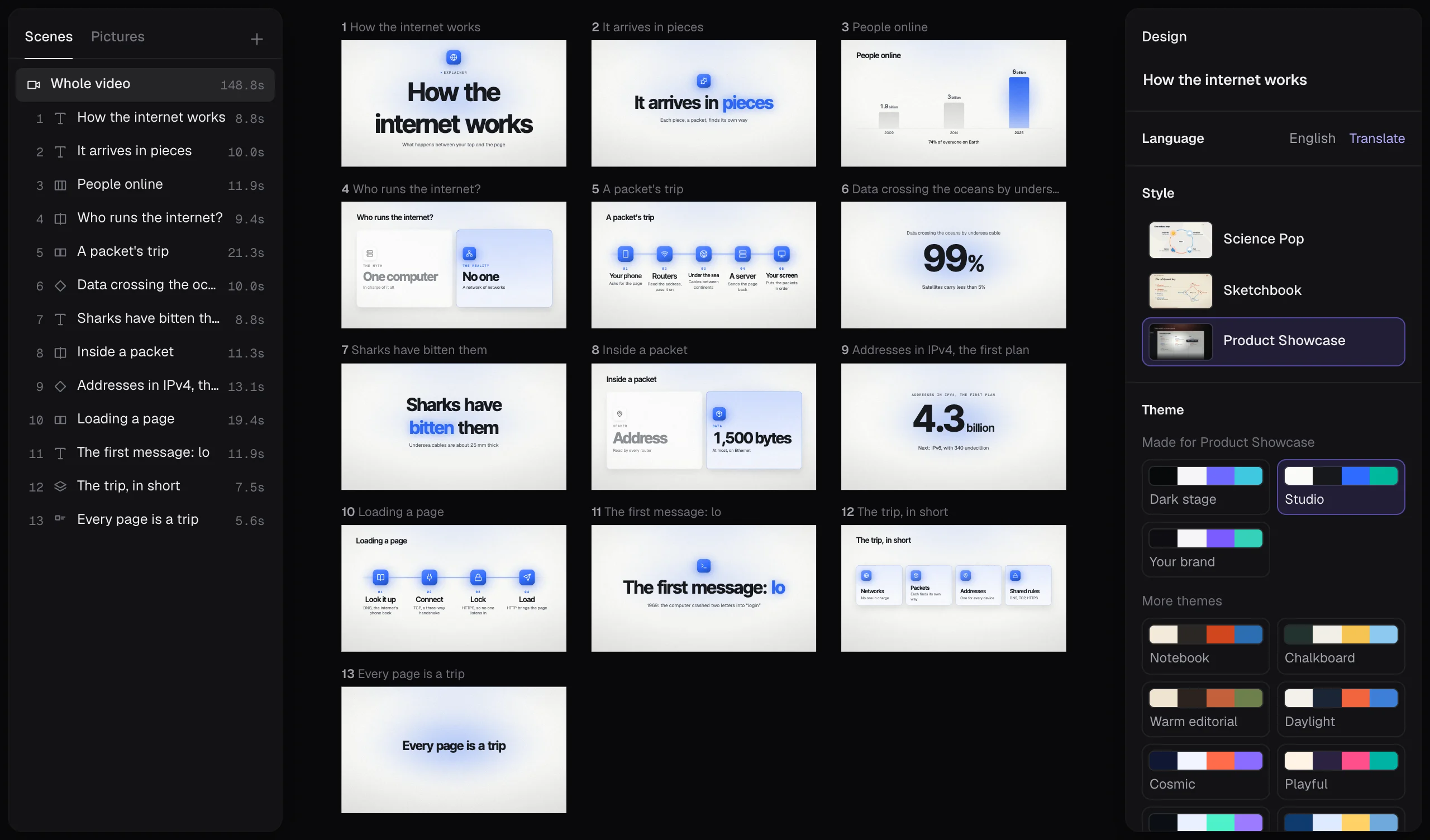
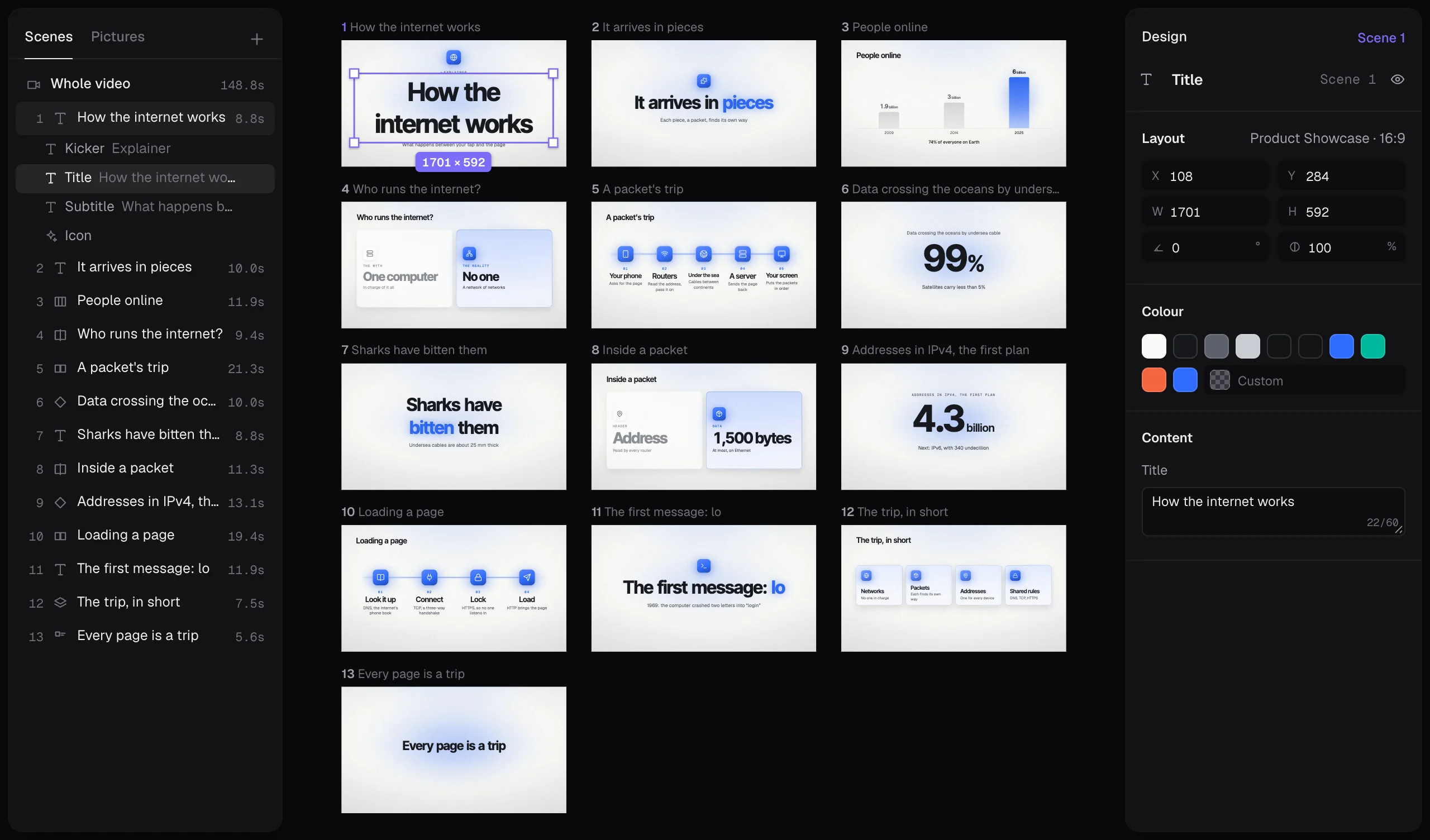
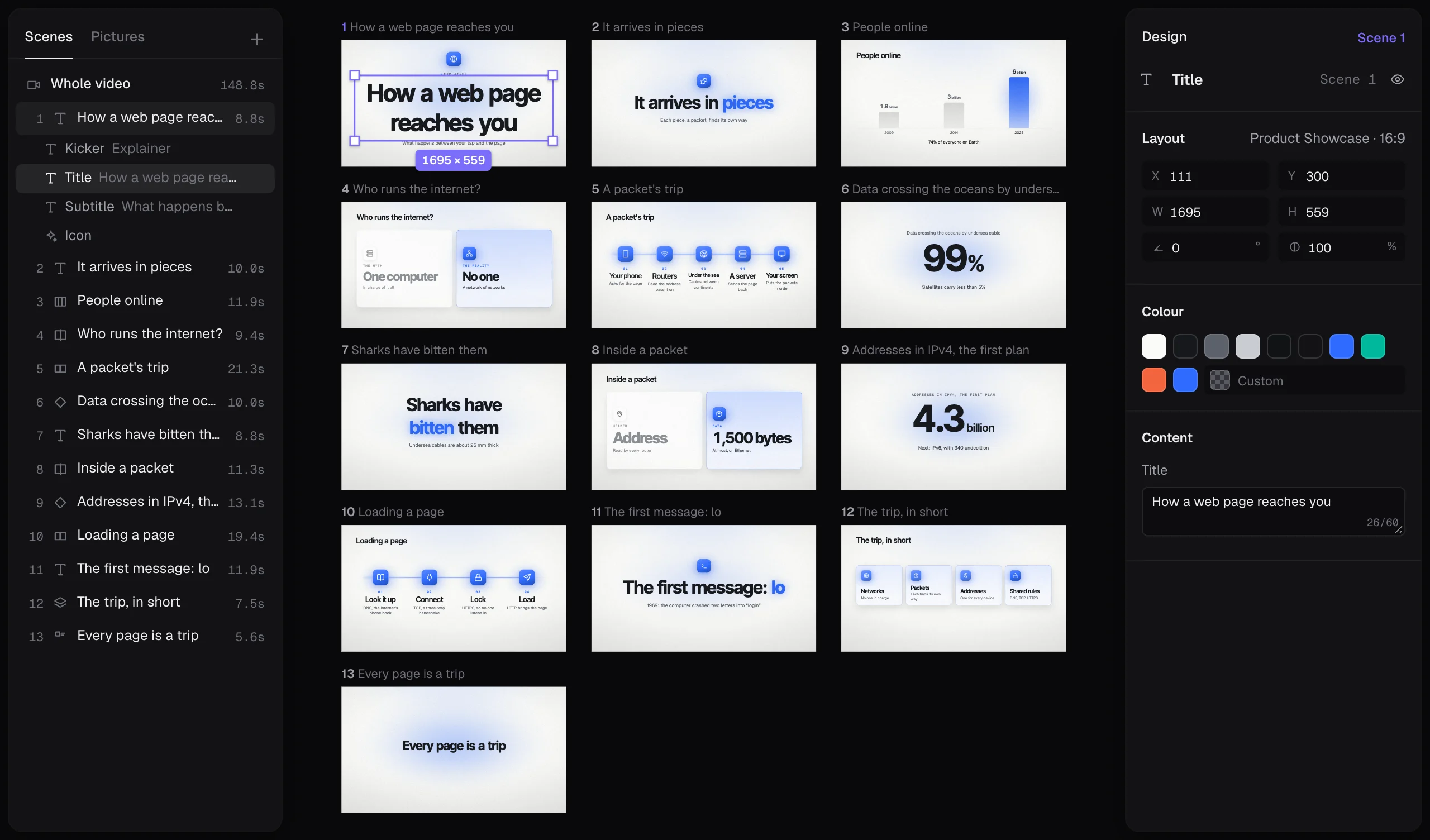
1. How the internet works8.8s
2. It arrives in pieces10.0s
3. People online11.9s
4. Who runs the internet?9.4s
5. A packet's trip21.3s
6. Data crossing the oceans by undersea cable10.0s
7. Sharks have bitten them8.8s
8. Inside a packet11.3s
9. Addresses in IPv4, the first plan13.1s
10. Loading a page19.4s
11. The first message: lo11.9s
12. The trip, in short7.5s
13. Every page is a trip5.6s
Tap a link, and a page appears almost at once.
Here's the trip it takes to reach you.
That page doesn't travel in one piece.
It's split into small packets, and each one can take its own path.
In 2009, 1.9 billion people were online.
By 2014, over 3 billion.
In 2025, 6 billion: 74 percent of the world.
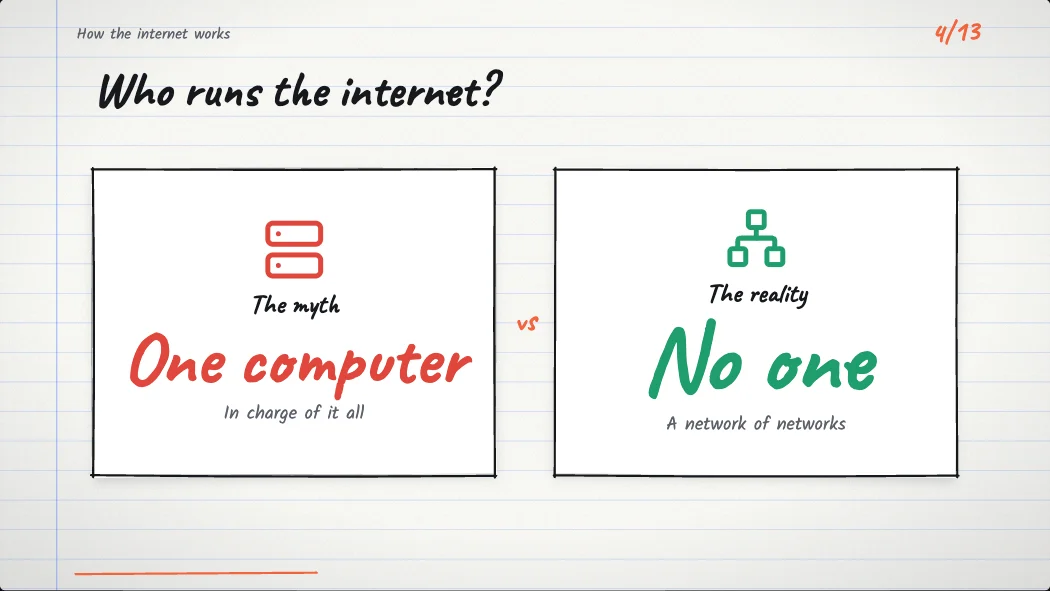
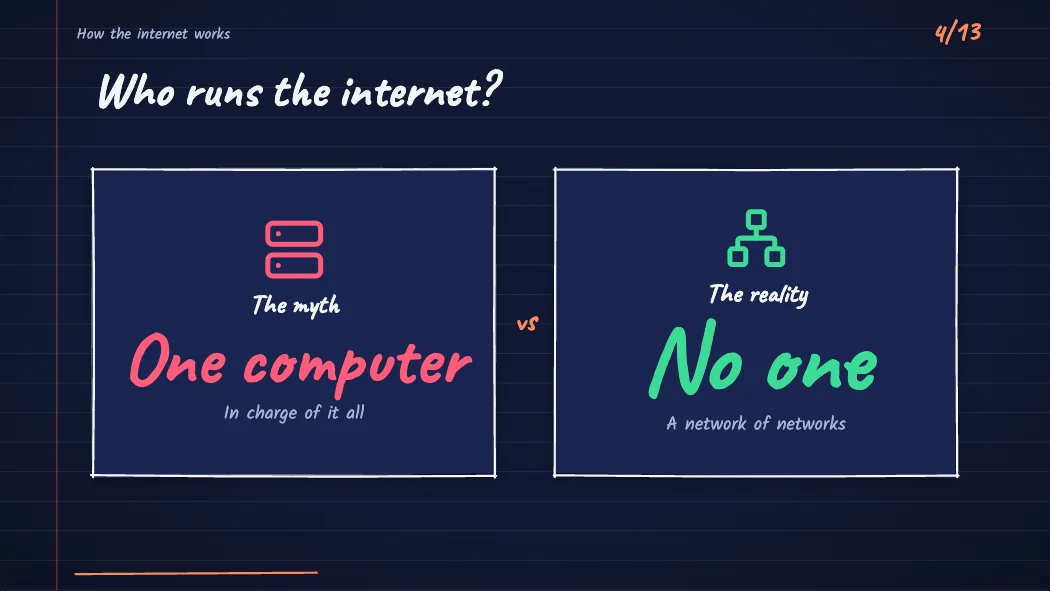
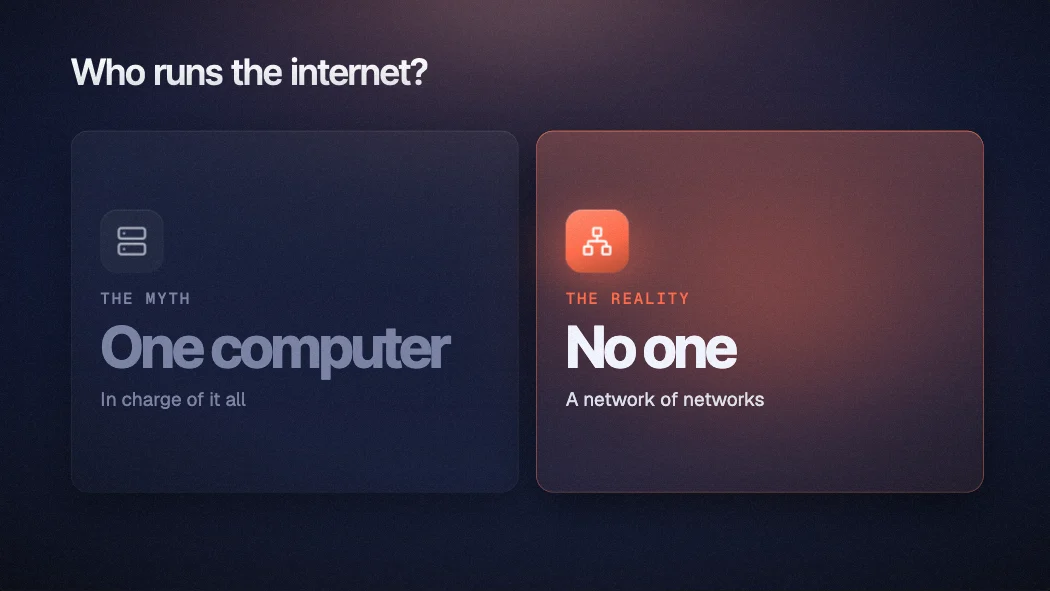
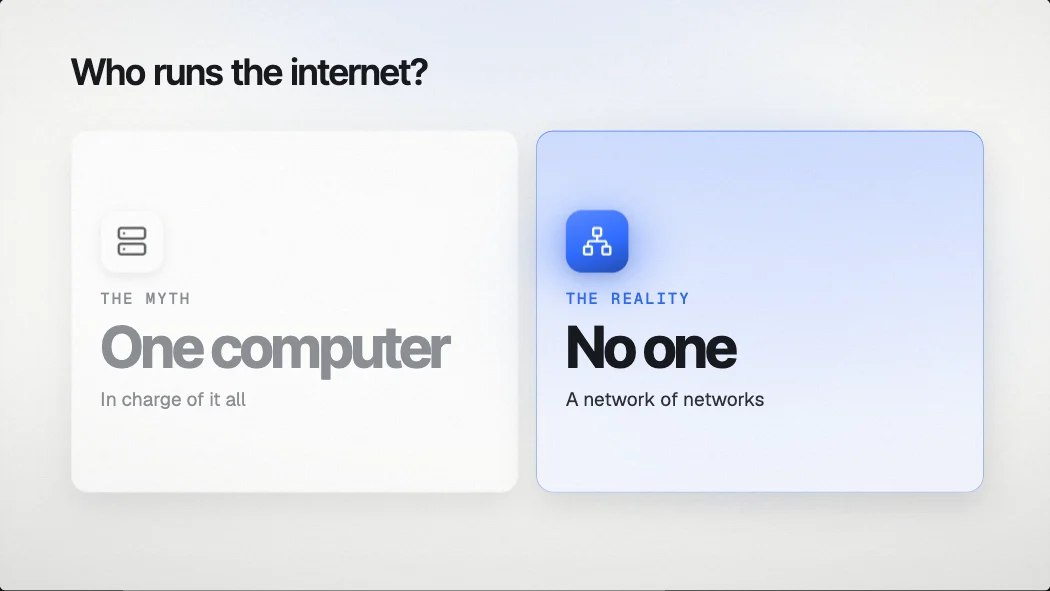
So who runs it? Not one giant computer.
It's a network of networks, and no one is in charge.
Your phone sends a request.
Routers read each packet's address, and pass it on.
Between continents, it races through cables on the sea floor.
A server finds the page, and sends it back in packets.
Your phone puts them back in order.
In fact, 99 percent of the data crossing oceans goes by cable.
Satellites carry less than 5 percent.
Those cables are only about 25 millimetres thick.
And sharks have been caught biting them.
Every packet starts with a header: the address routers read.
Then the data itself: on Ethernet, at most 1,500 bytes.
Every device online needs an address.
The first plan, IPv4, allowed about 4.3 billion.
They ran out in 2011, so IPv6 has 340 undecillion.
Loading a page takes a few quick steps.
DNS looks up the site's address, like a phone book.
TCP connects with a three-way handshake.
HTTPS encrypts it, so no one can listen in.
Then HTTP asks for the page.
It all began in 1969, with a message meant to say login.
The computer crashed after two letters. So the first word sent was lo.
So: networks of networks, packets with addresses, and rules they all share.
Next time a page loads, picture the trip it took.
Music · drive
16:9 1920 × 1080 · 139.0 s
0:000:100:200:300:400:501:001:101:201:301:401:502:002:10
1. How the internet works8.3s
2. It arrives in pieces9.2s
3. People online11.4s
4. Who runs the internet?8.7s
5. A packet's trip20.3s
6. Data crossing the oceans by undersea cable9.2s
7. Sharks have bitten them8.0s
8. Inside a packet10.5s
9. Addresses in IPv4, the first plan12.3s
10. Loading a page18.3s
11. The first message: lo11.0s
12. The trip, in short6.9s
13. Every page is a trip5.1s
Tap a link, and a page appears almost at once.
Here's the trip it takes to reach you.
That page doesn't travel in one piece.
It's split into small packets, and each one can take its own path.
In 2009, 1.9 billion people were online.
By 2014, over 3 billion.
In 2025, 6 billion: 74 percent of the world.
So who runs it? Not one giant computer.
It's a network of networks, and no one is in charge.
Your phone sends a request.
Routers read each packet's address, and pass it on.
Between continents, it races through cables on the sea floor.
A server finds the page, and sends it back in packets.
Your phone puts them back in order.
In fact, 99 percent of the data crossing oceans goes by cable.
Satellites carry less than 5 percent.
Those cables are only about 25 millimetres thick.
And sharks have been caught biting them.
Every packet starts with a header: the address routers read.
Then the data itself: on Ethernet, at most 1,500 bytes.
Every device online needs an address.
The first plan, IPv4, allowed about 4.3 billion.
They ran out in 2011, so IPv6 has 340 undecillion.
Loading a page takes a few quick steps.
DNS looks up the site's address, like a phone book.
TCP connects with a three-way handshake.
HTTPS encrypts it, so no one can listen in.
Then HTTP asks for the page.
It all began in 1969, with a message meant to say login.
The computer crashed after two letters. So the first word sent was lo.
So: networks of networks, packets with addresses, and rules they all share.
Next time a page loads, picture the trip it took.
Music · drive
16:9 1920 × 1080 · 139.0 s
0:000:100:200:300:400:501:001:101:201:301:401:502:002:10
1. How the internet works8.3s
2. It arrives in pieces9.2s
3. People online11.4s
4. Who runs the internet?8.7s
5. A packet's trip20.3s
6. Data crossing the oceans by undersea cable9.2s
7. Sharks have bitten them8.0s
8. Inside a packet10.5s
9. Addresses in IPv4, the first plan12.3s
10. Loading a page18.3s
11. The first message: lo11.0s
12. The trip, in short6.9s
13. Every page is a trip5.1s
Tap a link, and a page appears almost at once.
Here's the trip it takes to reach you.
That page doesn't travel in one piece.
It's split into small packets, and each one can take its own path.
In 2009, 1.9 billion people were online.
By 2014, over 3 billion.
In 2025, 6 billion: 74 percent of the world.
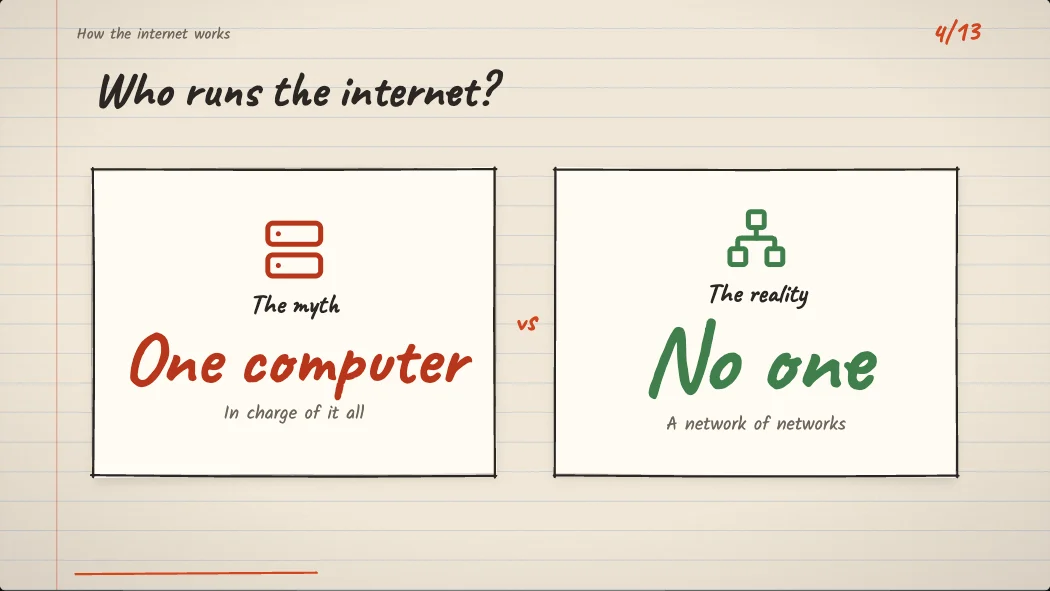
So who runs it? Not one giant computer.
It's a network of networks, and no one is in charge.
Your phone sends a request.
Routers read each packet's address, and pass it on.
Between continents, it races through cables on the sea floor.
A server finds the page, and sends it back in packets.
Your phone puts them back in order.
In fact, 99 percent of the data crossing oceans goes by cable.
Satellites carry less than 5 percent.
Those cables are only about 25 millimetres thick.
And sharks have been caught biting them.
Every packet starts with a header: the address routers read.
Then the data itself: on Ethernet, at most 1,500 bytes.
Every device online needs an address.
The first plan, IPv4, allowed about 4.3 billion.
They ran out in 2011, so IPv6 has 340 undecillion.
Loading a page takes a few quick steps.
DNS looks up the site's address, like a phone book.
TCP connects with a three-way handshake.
HTTPS encrypts it, so no one can listen in.
Then HTTP asks for the page.
It all began in 1969, with a message meant to say login.
The computer crashed after two letters. So the first word sent was lo.
So: networks of networks, packets with addresses, and rules they all share.
Next time a page loads, picture the trip it took.
Music · drive
16:9 1920 × 1080 · 139.0 s
0:000:100:200:300:400:501:001:101:201:301:401:502:002:10
1. How the internet works8.3s
2. It arrives in pieces9.2s
3. People online11.4s
4. Who runs the internet?8.7s
5. A packet's trip20.3s
6. Data crossing the oceans by undersea cable9.2s
7. Sharks have bitten them8.0s
8. Inside a packet10.5s
9. Addresses in IPv4, the first plan12.3s
10. Loading a page18.3s
11. The first message: lo11.0s
12. The trip, in short6.9s
13. Every page is a trip5.1s
Tap a link, and a page appears almost at once.
Here's the trip it takes to reach you.
That page doesn't travel in one piece.
It's split into small packets, and each one can take its own path.
In 2009, 1.9 billion people were online.
By 2014, over 3 billion.
In 2025, 6 billion: 74 percent of the world.
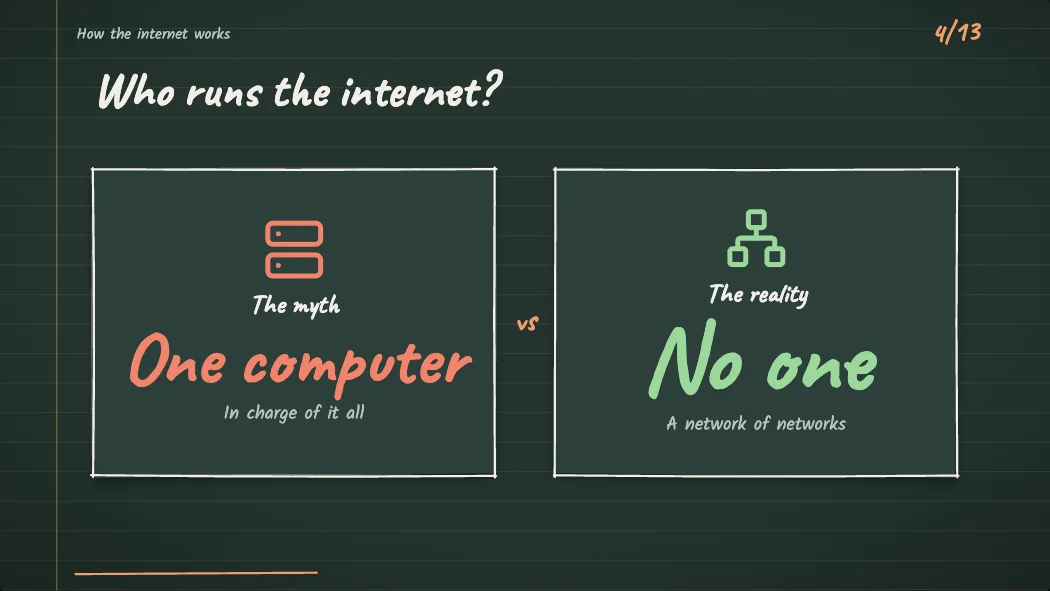
So who runs it? Not one giant computer.
It's a network of networks, and no one is in charge.
Your phone sends a request.
Routers read each packet's address, and pass it on.
Between continents, it races through cables on the sea floor.
A server finds the page, and sends it back in packets.
Your phone puts them back in order.
In fact, 99 percent of the data crossing oceans goes by cable.
Satellites carry less than 5 percent.
Those cables are only about 25 millimetres thick.
And sharks have been caught biting them.
Every packet starts with a header: the address routers read.
Then the data itself: on Ethernet, at most 1,500 bytes.
Every device online needs an address.
The first plan, IPv4, allowed about 4.3 billion.
They ran out in 2011, so IPv6 has 340 undecillion.
Loading a page takes a few quick steps.
DNS looks up the site's address, like a phone book.
TCP connects with a three-way handshake.
HTTPS encrypts it, so no one can listen in.
Then HTTP asks for the page.
It all began in 1969, with a message meant to say login.
The computer crashed after two letters. So the first word sent was lo.
So: networks of networks, packets with addresses, and rules they all share.
Next time a page loads, picture the trip it took.
Music · drive
16:9 1920 × 1080 · 139.0 s
0:000:100:200:300:400:501:001:101:201:301:401:502:002:10
1. How the internet works8.3s
2. It arrives in pieces9.2s
3. People online11.4s
4. Who runs the internet?8.7s
5. A packet's trip20.3s
6. Data crossing the oceans by undersea cable9.2s
7. Sharks have bitten them8.0s
8. Inside a packet10.5s
9. Addresses in IPv4, the first plan12.3s
10. Loading a page18.3s
11. The first message: lo11.0s
12. The trip, in short6.9s
13. Every page is a trip5.1s
Tap a link, and a page appears almost at once.
Here's the trip it takes to reach you.
That page doesn't travel in one piece.
It's split into small packets, and each one can take its own path.
In 2009, 1.9 billion people were online.
By 2014, over 3 billion.
In 2025, 6 billion: 74 percent of the world.
So who runs it? Not one giant computer.
It's a network of networks, and no one is in charge.
Your phone sends a request.
Routers read each packet's address, and pass it on.
Between continents, it races through cables on the sea floor.
A server finds the page, and sends it back in packets.
Your phone puts them back in order.
In fact, 99 percent of the data crossing oceans goes by cable.
Satellites carry less than 5 percent.
Those cables are only about 25 millimetres thick.
And sharks have been caught biting them.
Every packet starts with a header: the address routers read.
Then the data itself: on Ethernet, at most 1,500 bytes.
Every device online needs an address.
The first plan, IPv4, allowed about 4.3 billion.
They ran out in 2011, so IPv6 has 340 undecillion.
Loading a page takes a few quick steps.
DNS looks up the site's address, like a phone book.
TCP connects with a three-way handshake.
HTTPS encrypts it, so no one can listen in.
Then HTTP asks for the page.
It all began in 1969, with a message meant to say login.
The computer crashed after two letters. So the first word sent was lo.
So: networks of networks, packets with addresses, and rules they all share.
Next time a page loads, picture the trip it took.
Music · drive
16:9 1920 × 1080 · 148.8 s
0:000:100:200:300:400:501:001:101:201:301:401:502:002:102:20
1. How the internet works8.8s
2. It arrives in pieces10.0s
3. People online11.9s
4. Who runs the internet?9.4s
5. A packet's trip21.3s
6. Data crossing the oceans by undersea cable10.0s
7. Sharks have bitten them8.8s
8. Inside a packet11.3s
9. Addresses in IPv4, the first plan13.1s
10. Loading a page19.4s
11. The first message: lo11.9s
12. The trip, in short7.5s
13. Every page is a trip5.6s
Tap a link, and a page appears almost at once.
Here's the trip it takes to reach you.
That page doesn't travel in one piece.
It's split into small packets, and each one can take its own path.
In 2009, 1.9 billion people were online.
By 2014, over 3 billion.
In 2025, 6 billion: 74 percent of the world.
So who runs it? Not one giant computer.
It's a network of networks, and no one is in charge.
Your phone sends a request.
Routers read each packet's address, and pass it on.
Between continents, it races through cables on the sea floor.
A server finds the page, and sends it back in packets.
Your phone puts them back in order.
In fact, 99 percent of the data crossing oceans goes by cable.
Satellites carry less than 5 percent.
Those cables are only about 25 millimetres thick.
And sharks have been caught biting them.
Every packet starts with a header: the address routers read.
Then the data itself: on Ethernet, at most 1,500 bytes.
Every device online needs an address.
The first plan, IPv4, allowed about 4.3 billion.
They ran out in 2011, so IPv6 has 340 undecillion.
Loading a page takes a few quick steps.
DNS looks up the site's address, like a phone book.
TCP connects with a three-way handshake.
HTTPS encrypts it, so no one can listen in.
Then HTTP asks for the page.
It all began in 1969, with a message meant to say login.
The computer crashed after two letters. So the first word sent was lo.
So: networks of networks, packets with addresses, and rules they all share.
Next time a page loads, picture the trip it took.
Music · drive
16:9 1920 × 1080 · 148.8 s
0:000:100:200:300:400:501:001:101:201:301:401:502:002:102:20
1. How the internet works8.8s
2. It arrives in pieces10.0s
3. People online11.9s
4. Who runs the internet?9.4s
5. A packet's trip21.3s
6. Data crossing the oceans by undersea cable10.0s
7. Sharks have bitten them8.8s
8. Inside a packet11.3s
9. Addresses in IPv4, the first plan13.1s
10. Loading a page19.4s
11. The first message: lo11.9s
12. The trip, in short7.5s
13. Every page is a trip5.6s
Tap a link, and a page appears almost at once.
Here's the trip it takes to reach you.
That page doesn't travel in one piece.
It's split into small packets, and each one can take its own path.
In 2009, 1.9 billion people were online.
By 2014, over 3 billion.
In 2025, 6 billion: 74 percent of the world.
So who runs it? Not one giant computer.
It's a network of networks, and no one is in charge.
Your phone sends a request.
Routers read each packet's address, and pass it on.
Between continents, it races through cables on the sea floor.
A server finds the page, and sends it back in packets.
Your phone puts them back in order.
In fact, 99 percent of the data crossing oceans goes by cable.
Satellites carry less than 5 percent.
Those cables are only about 25 millimetres thick.
And sharks have been caught biting them.
Every packet starts with a header: the address routers read.
Then the data itself: on Ethernet, at most 1,500 bytes.
Every device online needs an address.
The first plan, IPv4, allowed about 4.3 billion.
They ran out in 2011, so IPv6 has 340 undecillion.
Loading a page takes a few quick steps.
DNS looks up the site's address, like a phone book.
TCP connects with a three-way handshake.
HTTPS encrypts it, so no one can listen in.
Then HTTP asks for the page.
It all began in 1969, with a message meant to say login.
The computer crashed after two letters. So the first word sent was lo.
So: networks of networks, packets with addresses, and rules they all share.
Next time a page loads, picture the trip it took.
Music · drive
16:9 1920 × 1080 · 148.8 s

1701 × 592
16:9 1920 × 1080 · 148.8 s
1695 × 559
16:9 1920 × 1080 · 148.8 s